


In the dynamic landscape of display production, the quest for cutting - edge technologies is relentless. As a supplier of Excimer System, I'm often asked whether an excimer system can be effectively used in the production of displays. In this blog post, we'll delve deep into the technical details, advantages, and challenges of employing excimer systems in display manufacturing.
Understanding the Excimer System
Before we explore its application in display production, let's first understand what an excimer system is. An excimer system consists of Excimer Equipment and Excimer Lamp. Excimers, short for "excited dimers," are molecules that exist only in an excited state. When they return to their ground state, they emit intense ultraviolet (UV) light. This UV emission is the key characteristic of an excimer system.
The excimer lamps within the system are designed to generate specific wavelengths of UV light. Different gas mixtures are used in the lamps to produce various wavelengths, which range from the vacuum ultraviolet (VUV) to the ultraviolet - C (UVC) region. These wavelengths offer unique photochemical and physical properties that can be harnessed in different industrial processes.
Applications of Excimer Systems in Display Production
1. Photolithography
Photolithography is a crucial step in display manufacturing, especially for the production of thin - film transistors (TFTs) and micro - LEDs. In photolithography, a photosensitive material (photoresist) is coated on the substrate, and UV light is used to transfer a circuit pattern from a photomask to the photoresist.
Excimer systems can provide high - energy, short - wavelength UV light, which is ideal for high - resolution photolithography. For example, the 193 - nm wavelength emitted by an ArF excimer lamp has a much shorter wavelength compared to traditional mercury lamps. This short wavelength allows for the creation of finer patterns on the photoresist, enabling the production of displays with higher pixel densities and better image quality.

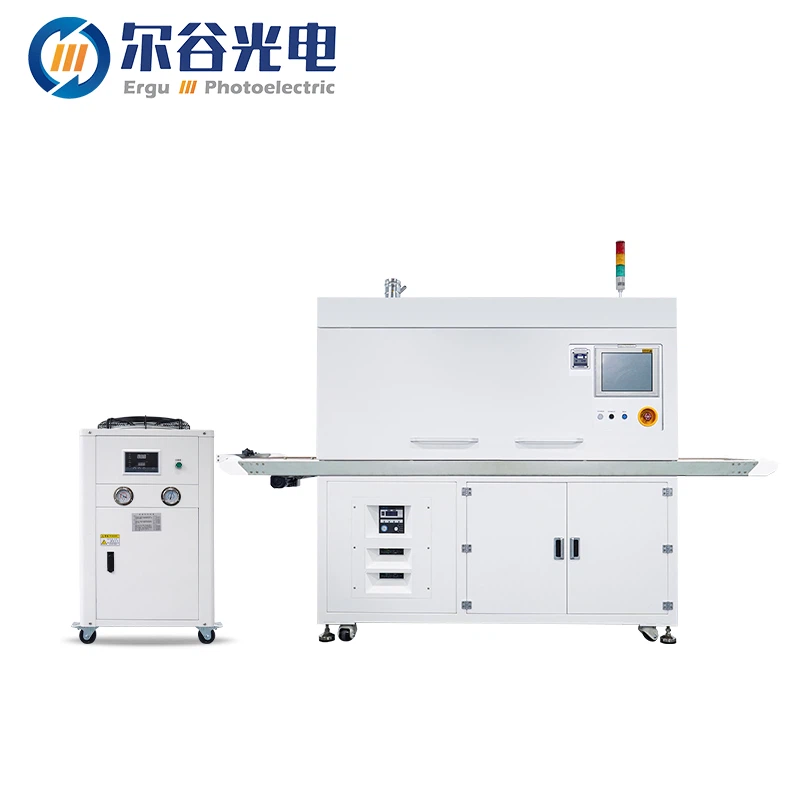
Moreover, the excimer - based photolithography process can achieve a higher degree of accuracy and precision. The high - intensity UV light ensures a more uniform exposure of the photoresist, reducing the occurrence of pattern errors and improving the overall yield of the display manufacturing process.
2. Surface Cleaning and Treatment
During display production, the cleanliness of the substrate surface is of utmost importance. Any contaminants on the surface can lead to defects in the display, such as dead pixels or uneven color distribution.
Excimer systems are excellent tools for surface cleaning and treatment. The high - energy UV light emitted by the excimer lamps can break down organic contaminants on the substrate surface through photochemical reactions. The short wavelengths of the UV light can also generate ozone, which further aids in the oxidation and removal of contaminants.
In addition to cleaning, excimer systems can also modify the surface properties of the substrate. For instance, they can increase the surface energy of the substrate, improving the adhesion between the substrate and subsequent layers in the display manufacturing process. This is particularly important for the deposition of thin films, such as indium tin oxide (ITO) electrodes, where good adhesion is essential for the performance and reliability of the display.
3. Annealing
Annealing is a heat - treatment process used to modify the physical properties of materials. In display production, annealing is often used to improve the crystallinity of semiconductor materials, such as amorphous silicon (a - Si), used in TFTs.
Excimer systems can offer a rapid and precise annealing process. The intense UV light can heat the material surface within a short period, causing the atoms to re - arrange and form a more ordered crystalline structure. This excimer - based annealing process, known as excimer laser annealing (ELA), has several advantages over traditional furnace annealing. ELA is a localized process, which means that it can selectively anneal specific regions of the substrate without affecting the surrounding areas. This is particularly useful for displays with complex circuit designs, where targeted annealing can improve the electrical performance of individual TFTs.
Advantages of Using Excimer Systems in Display Production
1. High Precision
As mentioned earlier, the short - wavelength UV light emitted by excimer systems enables high - resolution photolithography. This high precision is essential for the production of high - end displays, such as OLEDs and 8K LCDs, which require extremely fine circuit patterns and pixel structures.
2. Energy Efficiency
Excimer lamps are more energy - efficient compared to traditional light sources used in display manufacturing. They can convert a higher percentage of electrical energy into UV light, reducing the overall energy consumption of the production process. This not only lowers the operating costs but also makes the production process more environmentally friendly.
3. Process Flexibility
The ability to adjust the wavelength and intensity of the UV light emitted by excimer systems provides great flexibility in the display manufacturing process. Different types of displays may require different processing conditions, and excimer systems can be easily customized to meet these specific requirements.
4. Improved Product Quality
The use of excimer systems in surface cleaning, photolithography, and annealing can significantly improve the quality of the displays. By reducing contaminants, improving pattern accuracy, and enhancing the physical properties of materials, excimer systems can help produce displays with better image quality, higher reliability, and longer lifetimes.
Challenges and Considerations
1. Cost
The initial investment in an excimer system can be relatively high. The excimer lamps and associated equipment require specialized technology and manufacturing processes, which contribute to the high cost. However, it's important to consider the long - term benefits, such as improved product quality and yield, which can offset the initial investment over time.
2. Maintenance
Excimer systems require regular maintenance to ensure optimal performance. The excimer lamps have a limited lifespan, and they need to be replaced periodically. Additionally, the optical components of the system, such as lenses and mirrors, need to be cleaned and calibrated regularly to maintain the quality of the UV light output.
3. Safety
The high - energy UV light emitted by excimer systems can be harmful to human health. Proper safety measures, such as using protective UV - blocking glasses and enclosures, need to be in place to prevent exposure to the UV light.
Conclusion
In conclusion, an excimer system can indeed be effectively used in the production of displays. Its applications in photolithography, surface cleaning, and annealing offer significant advantages in terms of precision, energy efficiency, process flexibility, and product quality. Although there are challenges such as cost, maintenance, and safety, the long - term benefits make it a valuable investment for display manufacturers.
If you're in the display production industry and are interested in exploring how our Excimer System can enhance your manufacturing process, we'd be delighted to have a discussion with you. Contact us to start a conversation about how we can meet your specific needs and achieve better results in your display production.
References
- Sze, S. M. (1981). Physics of Semiconductor Devices. John Wiley & Sons.
- Kinoshita, A., & Yamanaka, Y. (2006). Excimer Laser Annealing of Amorphous Silicon Films for Display Applications. Journal of the Vacuum Society of Japan, 49(3), 213 - 218.
- Helbig, N., & Kasparek, W. (1997). Excimer Lamps - Ultraviolet Sources for Modern Technologies. Journal of Physics D: Applied Physics, 30(19), 2576 - 2586.


