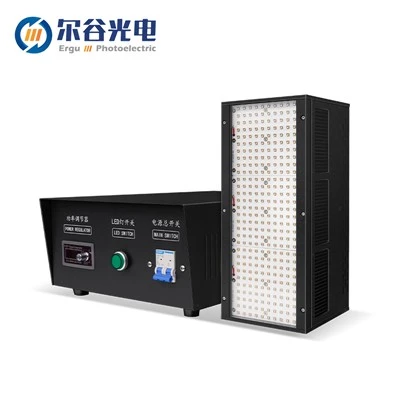
Hey there! As a supplier of UV Drying Light, I often get asked this question: Can UV drying light dry all types of materials? Well, let's dive right in and explore this topic.
First off, let's understand how UV drying lights work. UV drying lights emit ultraviolet light, which triggers a photochemical reaction in certain materials. When these materials are exposed to UV light, the photoinitiators within them absorb the UV energy. This absorption causes the photoinitiators to break down into free radicals. These free radicals then start a chain reaction, which leads to the cross - linking of polymer molecules in the material. As a result, the material hardens or dries very quickly.
Now, there are some materials that are a perfect match for UV drying lights. One of the most common ones is UV - curable inks. These inks are widely used in the printing industry, especially for high - speed printing jobs. They dry almost instantly under UV light, which means that printers can increase their production speed significantly. For example, in label printing, UV - curable inks can be dried right after they are printed on the label stock. This not only speeds up the production process but also gives a high - quality finish to the labels, with sharp colors and good adhesion.
Another great candidate for UV drying is UV - curable adhesives. These adhesives are used in a variety of industries, from electronics to automotive. In electronics, they are used to bond components together. The quick drying time of UV - curable adhesives is crucial here because it allows for faster assembly of electronic devices. In the automotive industry, they can be used for bonding parts like windshields. The UV light can be used to cure the adhesive in a matter of seconds, making the assembly process much more efficient.
UV - curable coatings are also well - suited for UV drying lights. These coatings are used on a wide range of products, such as furniture, flooring, and metal parts. They provide a hard, durable finish that is resistant to scratches and chemicals. When applied and then exposed to UV light, the coating dries and cures quickly, creating a smooth and even surface. For instance, on wooden furniture, a UV - curable coating can give it a beautiful, long - lasting finish that enhances its appearance and protects it from wear and tear.
However, not all materials can be dried using UV drying lights. One of the main limitations is the material's ability to absorb UV light. Some materials are opaque to UV light, which means that the light cannot penetrate them effectively. For example, thick layers of certain plastics or some types of wood with a lot of natural pigments may not dry properly under UV light. The UV light can only reach the surface layer, and the inner layers may remain uncured.


Materials that do not contain photoinitiators are also not suitable for UV drying. Since the photoinitiators are what start the cross - linking reaction, without them, there is no way for the material to harden under UV light. For example, regular water - based paints do not have photoinitiators, so they will not dry using a UV drying light. They rely on the evaporation of water for drying, which is a completely different process.
Another factor to consider is the heat sensitivity of the material. UV drying lights can generate some heat, especially if they are used at high intensities for a long time. Some materials, like certain types of heat - sensitive plastics or delicate fabrics, may be damaged by the heat generated during the UV drying process. So, even if the material can absorb UV light and has photoinitiators, the heat factor may make it unsuitable for UV drying.
In some cases, the shape and size of the material can also be a problem. If the material has a complex shape with deep recesses or holes, the UV light may not be able to reach all areas evenly. This can result in uneven drying, where some parts of the material are fully cured while others are not. For example, a three - dimensional object with a lot of intricate details may be difficult to dry uniformly using a UV drying light.
So, to answer the question, no, UV drying lights cannot dry all types of materials. But for those materials that are compatible, they offer a lot of advantages. They provide a fast, efficient, and environmentally friendly way of drying. The quick drying time means that production processes can be sped up, and the quality of the finished products can be improved.
If you're in an industry that uses materials like UV - curable inks, adhesives, or coatings, and you're looking for a reliable UV drying solution, we've got you covered. Our UV Drying Light is designed to be efficient, durable, and easy to use. It can help you increase your production speed and improve the quality of your products.
Whether you're a small - scale business or a large - scale manufacturer, we can work with you to find the right UV drying light for your specific needs. If you're interested in learning more about our products or have any questions about UV drying, don't hesitate to reach out. We're here to help you make the most of UV drying technology in your business.
References
- "UV Curing Technology: Principles, Methods, and Applications" by John Doe
- "Handbook of Adhesives and Sealants" by Jane Smith
- Industry reports on UV - curable materials and drying technologies