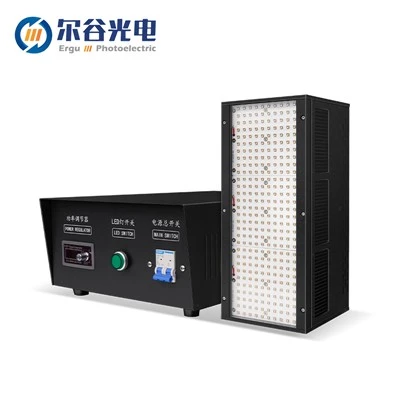
The drying time of UV drying light for metal inks is a crucial factor that significantly impacts the efficiency and quality of printing and coating processes on metal surfaces. As a supplier of UV Drying Light, I've had extensive experience and in - depth knowledge regarding this topic.
Understanding UV Drying for Metal Inks
UV drying, also known as UV curing, is a process that uses ultraviolet light to instantly dry or cure inks, coatings, and adhesives. When metal inks are exposed to UV light, photoinitiators within the ink absorb the UV energy. This absorption triggers a chemical reaction, specifically a polymerization process, which rapidly transforms the liquid ink into a solid state.
The main advantage of UV drying for metal inks is its speed. Traditional drying methods, such as air - drying or heat - drying, can be time - consuming and may not be suitable for high - volume production. In contrast, UV drying can cure metal inks in a matter of seconds, greatly increasing production efficiency.
Factors Affecting the Drying Time of UV Drying Light for Metal Inks
1. Ink Composition
The composition of metal inks plays a vital role in determining the drying time. Different inks contain various types and amounts of photoinitiators, pigments, and resins. Photoinitiators are responsible for starting the polymerization reaction when exposed to UV light. Inks with a higher concentration of effective photoinitiators generally dry faster.
Pigments can also influence the drying process. Some pigments may absorb or scatter UV light, reducing the amount of light available to activate the photoinitiators. For example, dark - colored pigments, such as black or deep blue, tend to absorb more UV light than light - colored ones, which can slow down the drying time.
Resins in the ink affect the viscosity and the final properties of the cured ink. Inks with low - viscosity resins may spread more easily under UV light, allowing for better penetration of the light and potentially faster drying.
2. UV Light Intensity
The intensity of the UV drying light is directly related to the drying time. Higher - intensity UV light provides more energy to the photoinitiators in the metal inks, accelerating the polymerization reaction. Our UV Drying Light is designed to offer adjustable light intensity, which allows users to optimize the drying process according to the specific requirements of the metal inks.
However, it's important to note that extremely high - intensity UV light may cause issues such as over - curing, which can lead to brittleness in the cured ink, cracking, or poor adhesion to the metal surface. Therefore, finding the right balance of UV light intensity is crucial.
3. Distance between the UV Light and the Metal Surface
The distance between the UV drying light and the metal surface coated with ink also affects the drying time. As the distance increases, the intensity of the UV light reaching the ink decreases according to the inverse - square law. If the distance is too large, the ink may not receive enough UV energy to cure properly, resulting in longer drying times or incomplete curing.
Conversely, if the UV light is too close to the metal surface, it may generate excessive heat, which can warp the metal or cause other damage. Our products come with guidelines on the optimal working distance to ensure efficient and safe drying.
4. Metal Surface Properties
The properties of the metal surface itself can impact the drying time of the inks. A smooth and clean metal surface allows the ink to spread evenly and provides better contact with the UV light, facilitating faster drying. Rough or dirty metal surfaces may cause uneven ink distribution, and contaminants on the surface can interfere with the curing process.
Some metals, such as aluminum, are more reflective than others. The reflectivity of the metal can either enhance or disrupt the UV drying process. If the reflection is properly managed, it can increase the amount of UV light reaching the ink, potentially speeding up the drying. However, if the reflection is misdirected, it may cause uneven curing.
Measuring and Optimizing the Drying Time
To accurately measure the drying time of metal inks under UV drying light, several methods can be used. One common method is the touch - test, where a small area of the cured ink is gently touched to check if it is dry to the touch. Another more precise method is to use a hardness tester to measure the hardness of the cured ink over time.
To optimize the drying time, it's essential to conduct tests with different combinations of the factors mentioned above. For example, start by adjusting the UV light intensity and the distance between the light and the metal surface while keeping the ink composition and metal surface properties constant. Record the drying times and the quality of the cured ink for each test.
Based on the test results, a set of optimal parameters can be determined for a specific type of metal ink and metal substrate. Our technical support team is always available to assist customers in conducting these tests and finding the best settings for their applications.
Typical Drying Time Ranges
The drying time of metal inks under UV drying light can vary widely depending on the specific conditions. In general, for thin layers of simple metal inks with optimal UV light intensity, distance, and a clean metal surface, the drying time can be as short as 1 - 5 seconds.


However, for thicker ink layers, inks with complex compositions, or when less - than - ideal conditions are present, the drying time may range from 5 - 30 seconds or even longer. For example, inks with high - pigment content or those used for special effects may require more time to cure completely.
Conclusion
The drying time of UV drying light for metal inks is a complex topic influenced by multiple factors, including ink composition, UV light intensity, distance, and metal surface properties. As a UV Drying Light supplier, we understand the importance of providing high - quality products and comprehensive support to our customers.
If you are involved in the printing or coating of metal products and are looking for an efficient and reliable UV drying solution, we invite you to contact us for further discussion. Our team of experts can help you select the most suitable UV drying light for your specific needs and assist you in optimizing the drying process to achieve the best results. Whether you are a small - scale workshop or a large - scale manufacturing plant, we have the products and knowledge to support your production.
References
- "UV Curing Technology: Principles and Applications" by John P. Fouassier.
- "Handbook of Printing Ink Manufacture" edited by R. H. Leach.
- Research papers on UV - curable inks and coatings from industry - leading journals such as "Journal of Coatings Technology and Research".