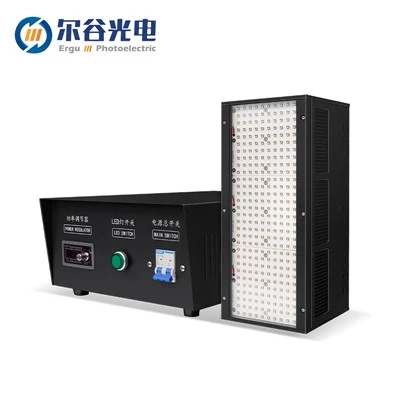
As a key technical tool in materials science and engineering, curing systems are widely used in coatings, electronic packaging, composite materials, and other fields. Different types of curing systems differ significantly in their mechanisms, performance, and applicable scenarios. They can be primarily categorized as thermal curing, light curing, moisture curing, and chemical curing.
Thermal curing is the most traditional curing method, initiating a cross-linking reaction in the resin through heating to form a stable three-dimensional network structure. Its advantages lie in its thorough curing and wide range of material compatibility, but it also requires high energy consumption and takes a long time to cure. It is commonly used in areas such as metal coatings and powder coatings. In contrast, light curing uses ultraviolet (UV) or visible light to trigger a photosensitizer reaction, achieving rapid curing. This energy-saving and high-efficiency approach makes it particularly suitable for precision electronic components and 3D printing materials. However, light curing requires high material transparency and has limited deep-layer curing capabilities.
Moisture curing relies on moisture in the environment to trigger a reaction, such as in polyurethane materials, and is suitable for sealing and bonding in humid environments. Its advantage is that it does not require additional energy, but its curing speed is significantly affected by humidity. Chemical curing initiates the reaction by adding a catalyst or curing agent. For example, in epoxy resin systems, the reaction rate can be controlled by adjusting the curing agent ratio. This makes it suitable for high-performance composite materials.
The selection of different curing systems requires a comprehensive consideration of material properties, process requirements, and cost-effectiveness. For example, the electronics industry favors light-curing for miniaturized production, while the construction industry relies more on moisture or chemical curing to adapt to complex environments. In the future, as environmental protection and efficiency requirements increase, the research and development of composite curing technologies and green curing systems will become important directions.