I. Why UTG Cannot Do Without UV Curing
UTG (Ultra-Thin Glass) has become the mainstream choice for foldable screen covers. The industry's mainstream thickness has reached around 30 microns, with optical transmittance of up to 93% and bending radii narrowed to the 0.4–1 mm range. But the physical nature of UTG has not changed: it is still glass, and after extreme thinning, its brittleness becomes prominent. The impact resistance and crack propagation resistance of bare glass are far from sufficient to directly withstand daily drops and stylus impacts.
The industry's solution is to build one or more layers of UV-curable coating on the UTG surface, using a polymer network to "supplement" the glass's brittleness. This coating is not decorative; it serves four functions: impact resistance, crack propagation suppression, stress buffering, and optical adjustment. The performance ceiling of the coating depends first on whether UV curing is "on target" – insufficient curing means the coating modulus cannot rise and bending durability cannot be achieved; over-curing or uncontrolled curing gradients make the coating brittle and concentrate interfacial stress, turning it into a crack initiation source during bending.
In other words, the position of UV curing equipment in the UTG process has shifted from an early "auxiliary curing unit" to core process equipment that affects UTG cover yield and reliability.
II. Four Key Roles of UV Curing in UTG
1. Curing of impact-resistant protective coatings: Raising bare UTG impact resistance by an order of magnitude
Bare UTG is prone to catastrophic radial cracking in pen-drop tests. A study published in 2026 showed that after coating UTG with a 40-micron-thick UV-cured polyurethane acrylate (PEUA) coating, the pen-drop failure height increased by 16 cm compared with bare UTG, and the failure mode changed from "through-thickness radial cracking" to "local indentation without propagation." The coating simultaneously maintained optical transmittance greater than 92% at 550 nm, achieved a storage modulus of approximately 2.18 GPa, and passed 200,000 inner-fold cycles at R=3 mm with no creases and no delamination.
The performance window of such coatings is highly dependent on UV curing conditions. With insufficient curing, crosslink density is low, and both modulus and impact resistance are compromised; over-curing may sacrifice toughness. What the equipment side needs to do is, given a fixed coating formulation, keep UV dose, spectral matching, and curing uniformity within the formulation window, so that the coating lands at the design point between "rigid" and "tough."
2. Curing of optical adhesives (OCA): The hidden variable in crease management
The bending zone of a foldable screen is not a single material under stress, but a multi-layer synergy of UTG, OCA, OLED modules, and support structures. OCA plays the role of interlayer stress transfer and buffering during bending. Its crosslink density and curing degree directly determine viscoelastic behavior, which in turn affects creep and crease appearance after long-term bending.
The influence path of UV curing equipment here is very direct: the consistency of curing degree determines whether the OCA modulus distribution is uniform across the entire sheet. If there is a difference in the curing degree of OCA in the bending zone versus the non-bending zone, the stress buffering capacity will be spatially non-uniform, and creases often first initiate at the "soft points" or "hard points" of the curing gradient. For 30-micron UTG, the tolerance for such non-uniformity is extremely narrow.
3. Curing of hard coatings (HC) and functional coatings: The common foundation of wear resistance and optical stability
The HC layer on the UTG cover surface is a typical UV-cured acrylate system, where hardness, wear resistance, and bending durability are all determined by crosslink density. Anti-reflection layers, anti-fingerprint layers, and nano-texture layers also fall within the scope of UV-cured coatings. Whether their curing degree is consistent directly affects the batch-to-batch stability of haze and transmittance.
An engineering fact that is easily underestimated: when forming a film on 30–50 micron glass, once coating thickness deviation enters the micron range, a UV absorption gradient appears – more UV is absorbed at the surface and less at the bottom, creating a false cure of "dry on top, uncured underneath." This defect is often invisible in factory optical inspection, yet after hundreds of thousands of bending cycles on the customer side, it manifests as interfacial cracking or coating peeling. The equipment-side countermeasure is not simply "increasing power," but matching the spectrum to the coating's absorption characteristics and ensuring controllability of energy distribution within the curing chamber.
4. UV debonding adhesives and temporary bonding: The "invisible process" in yield engineering
In UTG thinning, cutting, and stacking processes, UV debonding adhesives are used for temporary fixation and stacking of intermediate UTG sheets. Controlled debonding is achieved through irradiation by UV curing equipment, improving subsequent processing space and overall production yield. In addition, UTG laser cutting protection solutions also involve the coating and curing of UV-curable adhesives to control chipping and residual adhesive. These processes do not directly appear in the final cover product, but the stability of each curing/debonding step cumulatively affects final yield.
III. Performance Data: What Level UTG Can Reach When UV Curing Is on Target
Looking at the above roles in the context of mass production, the contribution of UV curing to UTG performance can be anchored by several industry-disclosed indicators:
Bending life: The 30-micron UTG covers mass-produced by Biel Crystal show no obvious creases after 500,000 dynamic bends, with extreme testing reaching 2 million cycles and mass production yield stable above 96%. Behind this level, the curing quality of the protective coating and OCA is one of the necessary conditions. Academic data also point in the same direction: an optimized UV-cured PEUA coating at 40 microns thickness can support 200,000 inner folds at R=3 mm and possesses thermal recovery capability – after stress whitening from extreme bending at R=1.5 mm, optical transparency can be restored through brief heat treatment.
Yield: The overall yield in the UTG segment has exceeded 95%, but this figure is not uniformly distributed – special processes such as gradient annealing themselves have a yield of about 63%, and the number of suppliers capable of stable supply is limited. In coating and curing steps, coating uniformity and curing consistency are among the sources of yield divergence: when one piece of equipment must accommodate multiple coating formulations, the UV energy window must be recalibrated after product changeover, and inadequate calibration directly results in batch curing defects.
Penetration rate: UTG penetration in foldable screen covers has exceeded 70%, meaning UV curing equipment now faces not a niche validation market, but a production line system ramping up toward tens of millions of units. Equipment consistency, repeatability, and changeover efficiency directly correspond to the customer's available yield and unit cost.
IV. Implications for UV Curing Equipment Manufacturers: What Customers Are Really Buying
Working backward from the above process logic, the demand of UTG production lines for UV curing equipment can be summarized in three levels, rather than a single "wavelength + power" parameter:
First level: Spectral matching and controllable dose. UTG coating systems cover various photoinitiator systems such as polyurethane acrylate, acrylate, and epoxy acrylate, with different absorption windows. Equipment needs to provide sufficient irradiance in the target band while possessing calibratable and traceable dose control capability. The UTG protective coating curing conditions disclosed in patents are 20–100 mW/cm² for 1–5 minutes. This appears mild, but the premise is that the spectrum matches the photoinitiator. If the match is wrong, no amount of time can make up for it.
Second level: Curing uniformity, not peak intensity. When applying micron-level coatings on 30-micron glass, what customers are truly constrained by is the uniformity of energy distribution across the area. Coating thickness deviation translates into a UV absorption gradient. If the equipment's own energy distribution adds another layer of non-uniformity, the tolerance for curing gradient is rapidly exhausted. The weight of uniformity indicators in UTG scenarios is higher than in many traditional UV curing applications.
Third level: Thermal management and line takt. UTG coating thicknesses are often in the tens of microns, and the temperature rise during curing must be controlled within a range that does not introduce additional thermal stress. At the same time, the capacity ramp-up pace of the foldable screen supply chain requires the curing unit to be embedded in continuous, roll-to-roll, or high-takt sheet production lines, rather than being an isolated "curing box." If an equipment manufacturer can deliver spectrum–uniformity–thermal load–takt as a jointly tuned window, rather than just delivering a lamp, the adaptation value at the UTG customer end will be significantly different.
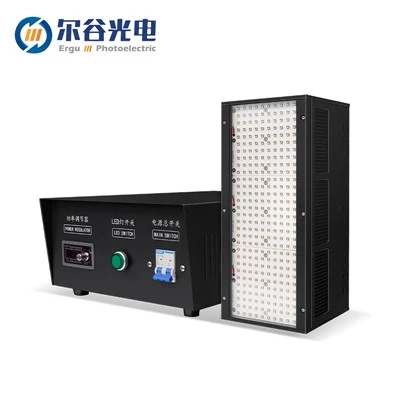
Ergu Optoelectronics' engineering approach in UTG curing scenarios is precisely organized around these three levels: the light source module supports spectral matching and dose calibration in the target band; energy distribution within the curing chamber is optimized through optical simulation; and thermal management and line takt are delivered together as jointly tuned parameters, rather than merely providing a "lamp that lights up."
UTG has transformed the foldable screen cover from "a piece of glass" into a multi-layer curing systems engineering challenge. UV curing is both the performance realization step for the protective coating and the common process foundation for OCA stress management and HC wear resistance. As UTG mass production yield continues to push upward from around 96%, as 30 microns becomes the mainstream thickness, and as cumulative foldable screen shipments approach the hundred-million-unit level, the value benchmark for curing equipment is shifting from "whether it can cure" to "whether curing is uniform, repeatable, and precisely aligned with the coating window."
For UV curing equipment manufacturers, UTG is not just another application scenario requiring "wavelength adaptation," but a process battleground where curing precision defines cover reliability. Whoever can turn spectral matching, area uniformity, and thermal–takt coordination into quantifiable, deliverable engineering capabilities will occupy a key position in the foldable screen cover yield curve. Ergu Optoelectronics' nearly twenty years of UV optics technology accumulation and 36-patent portfolio are precisely the underlying capabilities continuously refined around such high-precision curing scenarios.