Hey there! As a supplier of UV Glue Curing Lamps, I often get asked about how these nifty devices actually cure glue. So, I thought I'd break it down for you in a way that's easy to understand.
First off, let's talk about what UV glue is. UV glue, also known as ultraviolet light - curing adhesive, is a special type of glue that changes from a liquid to a solid state when exposed to ultraviolet (UV) light. This is different from traditional glues that dry through evaporation or a chemical reaction over time.
So, how does a UV Glue Curing Lamp make this happen? Well, it all comes down to the science of photopolymerization.
The Basics of Photopolymerization
Photopolymerization is a chemical process where a liquid polymer (the glue) is transformed into a solid polymer when it absorbs UV light. Inside the UV glue, there are special molecules called photoinitiators. These photoinitiators are like little triggers. When they absorb the energy from the UV light, they become activated.
Once activated, the photoinitiators start a chain reaction. They break the chemical bonds in the monomers (the building blocks of the polymer) in the glue. These broken - bond monomers then start to link up with each other, forming long chains. As more and more monomers join these chains, the liquid glue gradually turns into a solid.
How the UV Glue Curing Lamp Works
A UV Glue Curing Lamp is designed to emit the right kind of UV light to activate the photoinitiators in the glue. There are different types of UV light, but the most common ones used in curing lamps are UVA (320 - 400 nm), UVB (280 - 320 nm), and UVC (100 - 280 nm). Most UV glues are formulated to be sensitive to UVA light, so that's what you'll often find in these lamps.
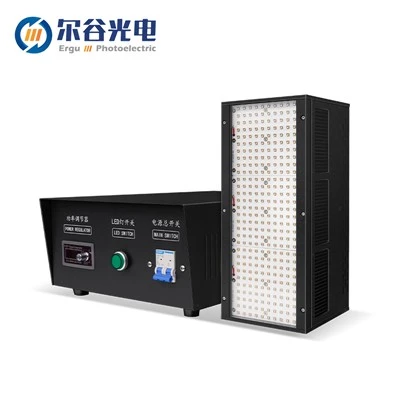
The lamp has a light source, usually a high - pressure mercury lamp or an LED. In the case of a high - pressure mercury lamp, when an electric current passes through the mercury vapor inside the lamp, it emits a spectrum of light that includes UV light. The lamp is also equipped with a reflector that helps to direct the UV light towards the glue.
LED - based UV Glue Curing Lamps are becoming more popular these days. They offer several advantages over mercury lamps. For one, they are more energy - efficient. They also have a longer lifespan and can be turned on and off instantly without the need for a warm - up time. Plus, they can be more precisely tuned to emit the specific wavelength of UV light that the glue needs.
Factors Affecting the Curing Process
There are a few things that can affect how well a UV Glue Curing Lamp cures the glue.


1. Wavelength of the UV Light
As I mentioned earlier, different glues are sensitive to different wavelengths of UV light. If the lamp emits the wrong wavelength, the photoinitiators in the glue won't be activated properly, and the glue won't cure. That's why it's important to choose a lamp that emits the right wavelength for the specific glue you're using.
2. Intensity of the UV Light
The intensity of the UV light also matters. If the light is too weak, the photoinitiators won't get enough energy to start the chain reaction. On the other hand, if the light is too strong, it can cause the glue to cure too quickly on the surface, while the inside remains uncured. This can lead to a brittle or unevenly cured bond.
3. Distance between the Lamp and the Glue
The distance between the lamp and the glue affects the intensity of the UV light that reaches the glue. If the lamp is too far away, the light will be spread out and less intense. If it's too close, the glue may get over - exposed in some areas. You need to find the right distance for the best curing results.
4. Thickness of the Glue Layer
Thicker layers of glue take longer to cure than thinner ones. This is because the UV light has to penetrate through the entire layer of glue to activate all the photoinitiators. If you're working with a thick layer of glue, you may need to increase the exposure time or use a more powerful lamp.
Applications of UV Glue Curing Lamps
UV Glue Curing Lamps have a wide range of applications. In the electronics industry, they are used to bond components together. For example, they can be used to attach a touchscreen to a display panel in a smartphone or a tablet. The fast - curing nature of UV glue means that the production process can be sped up.
In the dental industry, UV Glue Curing Lamps are used to cure dental fillings. The dentist applies the filling material (which is a type of UV - curable resin) to the tooth and then uses a lamp to harden it. This provides a strong and durable filling in a short amount of time.
They are also used in the printing industry. UV Ink Curing Lamps are used to dry and cure UV inks on various substrates, such as paper, plastic, and metal. This helps to produce high - quality prints with sharp colors and good adhesion.
Why Choose Our UV Glue Curing Lamps
As a supplier of UV Glue Curing Lamps, we take pride in offering high - quality products. Our lamps are designed to emit the precise wavelength and intensity of UV light needed for optimal glue curing.
We use advanced technology in our lamps, whether they are LED - based or mercury - lamp based. Our LED lamps are energy - efficient and can last for a long time, reducing your overall operating costs. We also offer a range of lamp sizes and shapes to suit different applications.
Our team of experts is always on hand to provide you with technical support and advice. Whether you're new to using UV glue and lamps or you're an experienced user, we can help you choose the right product for your needs.
If you're in the market for a reliable UV Glue Curing Lamp, we'd love to talk to you. We can offer you competitive prices and excellent customer service. So, don't hesitate to reach out to us to discuss your requirements and start a procurement partnership. Let's work together to get the best glue - curing solutions for your business.
References
- “Photopolymerization: Fundamentals and Applications.” Edited by J. P. Fouassier and J. F. Rabek.
- “UV Curing: Science and Technology” by Steven L. Cohen.
- Technical literature from leading UV lamp and glue manufacturers.