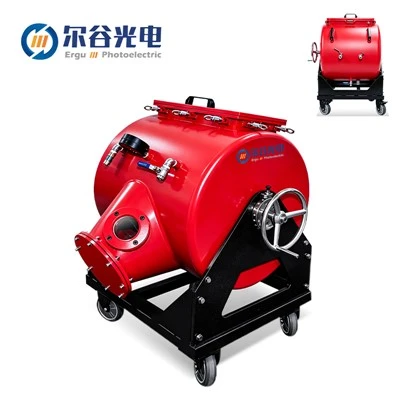
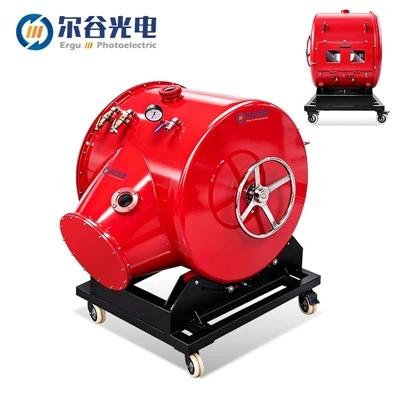
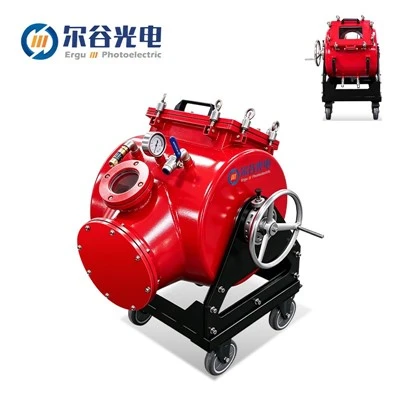
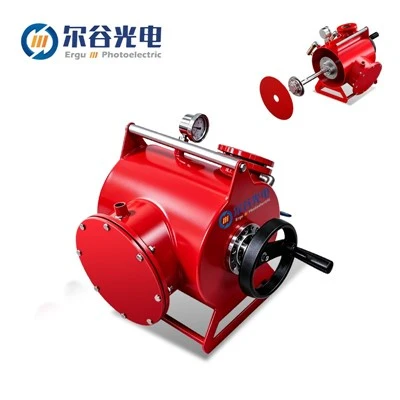
Urban underground pipeline networks are known as the "lifelines" of a city. As their service years increase, problems such as pipe aging, damage, and leakage become increasingly acute. Traditional excavation-based repair methods not only involve long construction periods and high costs but also severely disrupt urban traffic and the daily lives of residents. Since its origin in the United Kingdom in the 1970s, Cured-In-Place Pipe (CIPP) trenchless rehabilitation technology has become the most widely used trenchless pipeline rehabilitation method globally. The CIPP air inversion drum series equipment launched by Ergu Optoelectronics is becoming a key piece of equipment in the thermal curing CIPP process.


What is a CIPP air inversion drum?
The CIPP air inversion drum is the core equipment in the inversion method CIPP pipeline rehabilitation process. This process uses compressed air as the power source to invert a liner hose impregnated with thermosetting resin inside the pipe and uniformly conform it to the inner wall of the host pipe, followed by resin curing with hot water or steam. The air inversion drum performs the core function of controlling the hose inversion. Its pressure control precision at the inversion head, the stability of its air output, and its adaptability to different pipe diameters directly determine construction efficiency and the quality of the formed liner.
Taking the Ergu Optoelectronics QF260-150 air inverter as an example, this equipment is based on the thermal curing CIPP process. It uses compressed air to smoothly deliver the resin-impregnated liner hose into the pipe, invert it, and conform it to the pipe wall. Subsequent thermal curing forms a corrosion-resistant, high-strength "pipe-within-a-pipe" structure. The equipment accommodates various pipe diameters from DN60 to DN500 mm, delivers excellent inversion and conformity, and provides an efficient and reliable solution for the non-destructive rehabilitation of fire protection pipes and municipal drainage networks.
Technical advantages of air inversion
Compared with traditional water inversion methods, air inversion offers significant advantages. The Ergu Optoelectronics QF260-150 adopts a compressed air inversion process, which is simpler to operate and requires shorter on-site preparation time. The equipment features a lightweight design, weighing only 20 kg, making it easy to carry and operate, and allowing a single person to complete transport and setup. This characteristic makes it especially suitable for work in confined spaces such as underground utility tunnels and narrow manholes – traditional inversion equipment is often bulky and difficult to deploy in restricted spaces.
During the inversion and advancement phase, the air inversion drum delivers stable and balanced air pressure, driving the resin-impregnated liner hose to invert smoothly into the old pipe at a constant speed. Even when encountering small amounts of residual water, slight local offsets, or gradual diameter changes, the stable thrust ensures smooth passage without jamming. Once the pressure-holding and curing phase begins, continuous constant pressure causes the liner to expand uniformly and bond tightly to the inner wall of the original pipe, forming a dense "pipe-within-a-pipe" structure. Standardized pressure parameters ensure that construction quality no longer relies on individual experience, making the entire process controllable and reproducible.
Broad application scenarios
The application scenarios for the Ergu Optoelectronics CIPP air inversion drum are extensive. In the field of fire protection pipeline rehabilitation, fire protection pipes in buildings often suffer from leakage due to long-term corrosion, foundation settlement, and other factors. Fire protection networks are mostly buried underground or concealed within building walls. Traditional excavation repair requires demolishing building structures and damaging decorative finishes, making construction difficult and costly. The air inversion drum, however, can insert the liner hose into the pipeline through existing access openings, completing the repair without damaging the building structure. The rehabilitated fire protection pipes exhibit significantly improved impermeability, corrosion resistance, and durability.
In the municipal drainage sector, the air inversion drum is suitable for pipes ranging from DN60 to DN500, covering the trenchless rehabilitation of gravity pipelines such as municipal sewage pipes and rainwater pipes. From residential branch pipes to district trunk mains, a single unit can handle multiple pipe diameters, eliminating the need for frequent equipment changes. In the industrial pipeline sector, the equipment is equally suitable for the trenchless rehabilitation of chemical, gas, and other process pipelines.
Dual curing solutions to cover diverse rehabilitation needs
Ergu Optoelectronics has mastered the core technologies of both mainstream CIPP processes – UV curing and thermal curing. The UV curing system, with its advantages of rapid forming and low environmental impact, is suitable for scenarios with high construction efficiency requirements, such as urban arterial roads and commercial districts. The thermal curing air inversion drum, with its stable pneumatic control and wide pipe diameter compatibility, delivers outstanding performance in scenarios involving aging pipeline networks and complex terrain. The two solutions complement each other, forming a rehabilitation equipment system that covers diverse scenarios.
As global urbanization continues to advance and the demand for rehabilitating existing pipeline stocks is continuously released, CIPP trenchless rehabilitation technology is embracing unprecedented development opportunities. The Ergu Optoelectronics CIPP air inversion drum series equipment, backed by solid technical expertise and a deep understanding of frontline construction realities, is providing reliable Chinese equipment solutions for the safe operation and green renewal of urban underground pipeline networks.