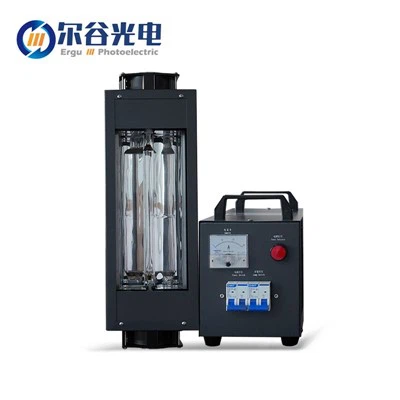
A high-pressure mercury lamp is a common high-intensity gas discharge lamp. Its operating principle is to excite mercury vapor through a high-voltage arc to generate ultraviolet light, which is then converted into visible light by phosphor. Its construction requires the precise design and manufacturing of multiple key components to ensure efficient and stable luminous performance.
The core components of a high-pressure mercury lamp include the discharge tube, electrodes, glass envelope, ballast, and phosphor coating. The discharge tube is typically made of quartz glass for its excellent high-temperature resistance and UV transparency. The tube is filled with an appropriate amount of mercury vapor and an inert gas (such as argon). When current is applied, the mercury vapor evaporates, forming an arc and releasing ultraviolet radiation. The electrodes are typically made of tungsten filaments and coated with an electron-emitting material (such as barium oxide) to reduce the starting voltage and maintain a stable arc discharge.
The glass envelope protects the discharge tube from external environmental influences. Some models also have a phosphor coating on the inner wall of the envelope, which converts the ultraviolet light generated by the mercury vapor into a broader spectrum of visible light, improving lighting efficiency. The ballast is an essential component of a high-pressure mercury lamp. It limits the current and provides the high voltage required for startup, ensuring stable lamp operation.
During the manufacturing process, the sealing of the discharge tube is crucial, ensuring that the mercury vapor pressure remains within the optimal range (typically 1-5 atmospheres) at high temperatures. Electrode positioning and welding accuracy directly impact arc stability, while the uniformity of the phosphor coating determines the color reproduction of the light.
The construction of high-pressure mercury lamps integrates materials science, vacuum technology, and optical design. Structural optimization directly impacts lamp life, luminous efficacy, and color rendering. Although LED technology has gradually replaced some mercury lamp applications in recent years, high-pressure mercury lamps still maintain their importance in industrial and outdoor lighting due to their high brightness and specific spectral characteristics.