Hey there! As a supplier of UV Glue Curing Lamp, I've been getting a lot of questions lately about the impact of a lamp's spectral purity on the curing quality of UV glue. So, I thought I'd take a deep dive into this topic and share what I've learned.
First off, let's talk about what spectral purity actually means. In simple terms, spectral purity refers to how well a light source emits light within a specific wavelength range. For UV glue curing lamps, we're mainly interested in the UV spectrum, typically around 365 - 405 nanometers. A lamp with high spectral purity emits most of its light within this narrow range, while a lamp with low spectral purity may emit light across a broader spectrum, including wavelengths that aren't useful or even harmful for curing UV glue.
Now, why does spectral purity matter when it comes to curing UV glue? Well, UV glue is formulated to react to specific wavelengths of UV light. When the glue is exposed to the right wavelengths, the photoinitiators in the glue absorb the light energy and start a chemical reaction that causes the glue to harden or cure. If the lamp has low spectral purity and emits a lot of light outside the optimal wavelength range, the glue may not cure properly.
One of the main issues with low spectral purity is that it can lead to uneven curing. Some parts of the glue may receive enough of the right wavelengths to cure, while other parts may not. This can result in a cured glue that has a sticky or tacky surface, or it may not have the full strength and durability that it should. For example, if you're using UV glue to bond two pieces of glass together, uneven curing could mean that the bond isn't as strong as it needs to be, and the glass pieces could come apart easily.
Another problem is that light outside the optimal wavelength range can cause premature degradation of the UV glue. Some wavelengths of light can break down the chemical bonds in the glue, even before the curing process is complete. This can weaken the glue and reduce its overall performance. Over time, the glue may become brittle, crack, or lose its adhesion, which is obviously not what you want when you're using it for a project.
On the other hand, a lamp with high spectral purity can provide several benefits for curing UV glue. First of all, it ensures more consistent and thorough curing. Since most of the light emitted is within the optimal wavelength range, the glue can absorb the energy evenly and cure uniformly. This results in a stronger, more durable bond that is less likely to fail.
High spectral purity also means that you can cure the glue more efficiently. The lamp can deliver the right amount of energy at the right wavelengths, which reduces the curing time. This is especially important in industrial applications where time is money. Faster curing times mean higher productivity and lower costs.
In addition, a lamp with high spectral purity can extend the lifespan of the UV glue. By minimizing the exposure to harmful wavelengths, the glue is less likely to degrade over time, which means it will maintain its performance for longer. This is great for applications where the glue needs to last for a long time, such as in outdoor signage or automotive parts.
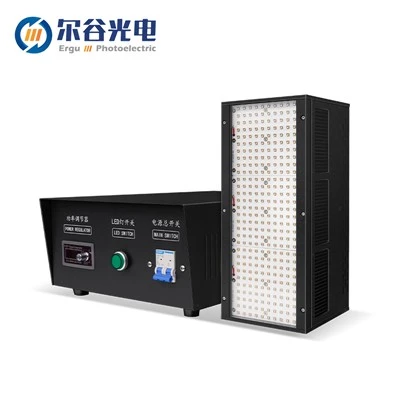
As a supplier of UV Glue Curing Lamp, we understand the importance of spectral purity. That's why we offer a range of lamps that are designed to provide high spectral purity and optimal performance for curing UV glue. Our UV Light Curing Lamp and UV Ink Curing Lamp are carefully engineered to emit light within the specific wavelength range that UV glue requires.
When choosing a UV glue curing lamp, there are a few things you should look for to ensure high spectral purity. First, check the lamp's specifications. The manufacturer should provide information about the wavelength range and the spectral purity of the lamp. Look for a lamp that has a narrow wavelength range and a high percentage of light emitted within the optimal range for UV glue curing.
You can also look for lamps that use advanced technology to control the spectral output. For example, some lamps use filters or special coatings to block out unwanted wavelengths and improve the spectral purity. These lamps may be more expensive, but they can provide better curing results and save you money in the long run by reducing the need for rework or replacement of failed bonds.
In conclusion, the spectral purity of a UV glue curing lamp has a significant impact on the curing quality of UV glue. A lamp with high spectral purity can provide more consistent, efficient, and durable curing, while a lamp with low spectral purity can lead to uneven curing, premature degradation, and other problems. As a supplier, we're committed to providing our customers with high-quality lamps that meet their needs and help them achieve the best possible results.
If you're in the market for a UV glue curing lamp, I encourage you to reach out to us to discuss your requirements. We can help you choose the right lamp for your application and provide you with all the information you need to make an informed decision. Whether you're a small business or a large industrial manufacturer, we have the expertise and the products to support your UV glue curing needs.
Let's work together to ensure that your UV glue curing projects are a success!
References


- "UV Curing Technology: Principles and Applications" by John W. Foltz
- "Handbook of Adhesive Technology" edited by Andrew Pizzi and K. L. Mittal